
This page is intended to serve as a rudimentary guide to the Iron Seas steampunk romance series. During the series development, I created many maps and wrote a detailed alternate history; at some point, I might make those available, but for now, I feel that a lot of that information constitutes spoilers (and I’d rather reveal most of this information in the books, because it’s much more fun that way.) I understand that trying to pick up all of this information from the books and mentally putting it in order can be challenging, however, so I’m including this basic info so that readers can have a better visual understanding of the geography and history as mentioned in the novels and novellas thus far.
THE UGLY (AND VERY BASIC) MAP
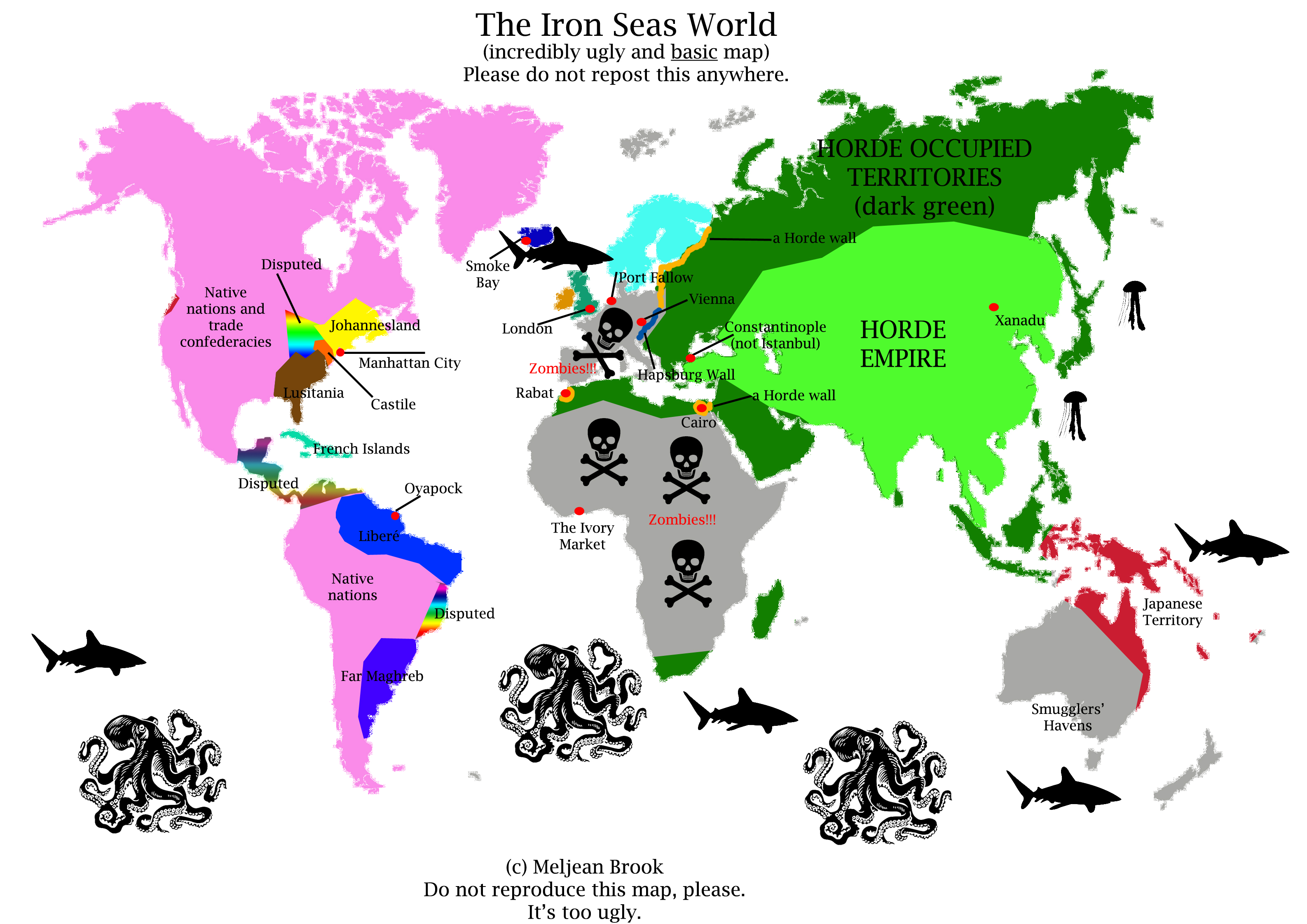
Click the image for a full-sized map.
Please note: I whipped up this map over the course of an evening in Photoshop, and so it’s not even close to exact. This is primarily to give you a rough idea of the placement of the new nations/kingdoms, but a lot of details are left out and the boundaries are … well, they are not exact, either. Please do not distribute this anywhere. This map will be a work in progress, and I’ll try to clean it up and update it as I have time, and I’d really, really hate the idea that I might have a more accurate version coming but this ugly thing is out there on a bunch of other sites. Please feel free to print it out or use it for reference as you’re reading; just don’t duplicate it anywhere online. Thank you so much!
THE GENERAL ALTERNATE HISTORY
WHAT HAPPENED THAT DIFFERENTIATES IRON SEAS HISTORY FROM OUR HISTORY?
In our history, two significant events helped form the shape of our world: In 1241, Ögedei Khan, son of Genghis Khan and second khagan of the Mongol Empire, died just as his armies were poised to invade Vienna and continue their conquest of the European continent. Upon receiving news of the Great Khan’s death, Ögedei’s general, Batu Khan, withdrew from Europe, but did not immediately attend the council to formally elect the new Great Khan. Although Guyuk was eventually named khagan in 1246, he died shortly thereafter. Subsequent arguments over succession divided the Mongols and fractured the empire. Though each khanate was still powerful, they did not reattempt their European invasion.
In 1266, Kublai Khan—grandson of Genghis Khan and the ruler who eventually established the Yuan dynasty—entrusted the Polo brothers with a message to Pope Clement IV, who died before they arrived in Rome. The message requested that the pope send one hundred Christian missionaries, including scholars and engineers. The man who would become Pope Gregory X received the missive, but only sent oil from the Holy Sepulcher back with the Polos, who were this time accompanied by Marco Polo.
In the Iron Seas history, Ögedei Khan still dies, but Batu Khan, leader of the Golden Horde, and son of Jochi—Genghis Khan’s eldest son—is named the successor over the wishes of Ögedei’s descendents and their supporters. In the civil war that follows, Batu, a brilliant strategist, crushes his opponents, but the effort prevents him from immediately returning to Europe. He relinquishes his westernmost holdings and consolidates his power in the east. His son, Sartaq, continues to strengthen the reunited empire, establishing strong civil and military presences in the outlying khanates. He is both generous and ruthless, ensuring their loyalty.
The empire is relatively stable by the time the Polo brothers make their first journey along the Silk Road to the emperor’s seat. Though not Kublai Khan, Batu’s successor is not a fool, and he takes similar steps to establish a relationship with the west. Batu and Sartaq had taken pains to maintain their trading routes and roads, so the Polos’ journey back to Rome passes quickly, and they arrive before Pope Clement IV dies. The pope partially fulfills the Great Khan’s request; though he didn’t send one hundred, a handful of scholars and engineers returned east with the Polo brothers, eager to spread both knowledge and Christianity. None were heard from again—except for Marco Polo, who escaped and related horrors of workshops, of men forced to invent machines of war, and who was ridiculed and called mad. For two hundred years, the history of the western world progressed similar to our own, aside from rumors about strange technologies in the east, all of which were dismissed as fables.
Then the first war machines rolled into western Asia, followed by the Horde.
#
Five hundred years later, the populations of Europe and Africa that managed to escape the Horde have fled to the New World, buffered by the protection of the oceans. The Horde has never developed a navy, but its armies and its machines have spread across Eurasia and Africa. What the Horde hasn’t destroyed, it has occupied—levying crippling taxes and enslaving the people, controlling them with the nanotech infecting their cells…and subjecting many to the horror of having their bodies modified to better suit their labor.
England, however, recently broke free from almost two centuries of control, and in a bloody revolution, overthrew Horde rule. But their freedom is tenuous, their position in the international arena weak, and the wounds of the occupation haven’t had time to heal…
A GENERAL HISTORY OF THE IRON SEAS WORLD
– The Horde was originally the Mongol Horde, which moved east and west from Mongolia, occupying and taking over territory in Asia. Some of the Japanese fled east across the Pacific and south to Australia. The territory under Genghis Khan’s expansion already extended to Persia, and Batu and his successors didn’t relinquish much to the west before moving their war machines into eastern Europe.
For a while, they were stopped at the Hapsburg Wall (the blue squiggle on the map). Leonardo da Vinci was instrumental in designing great machines that could act as defense along the wall. Part of the Horde’s armies turned their attentions south, eventually crossing into Egypt. Decades passed. Leonardo died. The Horde unleashed the zombie threat beyond the Hapsburg Wall and into Africa.
Some decided to flee Europe — first among them the sea-faring Portuguese, who settled Lusitania. The French, not yet touched by the zombie threat, sent ships to the west coast of Africa, trying to save kingdoms — the French took those who fled into the region between the Orinoco and the Great Cinnamon (the Amazon) rivers.
More Europeans flee, and the sea-faring Europeans escape and settle the New World before others. Many eastern Europeans went north, eventually making their way to Scandinavia. Eventually, the zombies cover most of Europe and Africa. The Horde builds outposts on both continents. Some cities in North Africa are protected by walls and occupied by Horde forces.
The Horde trades with England, including sugar and tea infected with nanoagents. England falls, the towers go up, and the rest of the British Isle is eventually infected as well.
In the New World, everything is chaos. Illness and diseases are rampant, devastating some of the native populations. Trade agreements are made with the natives, between settlements. Battles for territory are fought. (I’ll go into more of this specific history over the course of the series.) Eventually, it shakes out so that during the series, the major players are:
Lusitania — Portuguese speaking, primarily agricultural- and fishing-based economy, with a parliamentary system of government.
Castile — Spanish speaking, with a sharp divide between the industrial cities and agrarian rural communities. Ruled by a monarchy, plagued by assassinations and riots.
The native trade confederacies — United common-language groups of natives, primarily from the east and midwest, who formed confederacies to deal with the influx of Europeans. To the west and south, the tribes are still more disparate — though pressure from the encroaching trade confederacies to the east and Europeans is forcing change. Please note: The boundaries on the maps below show territories like Lusitania, Castile, and so on — this is also ALL native territory. Some kingdoms and territories have stronger alliances with different trade confederacies than others, and in some areas the populations have intermixed and integrated better than others, but it should be understood that the native populations are a strong presence within the territories the Europeans have claimed for their own.
The French Islands — the last remaining territory held by the French monarch. Though the French once had the strongest, richest kingdom due to a central trading location and the goods that came from the Libere territory, they’ve lost their grip. Still, French is the common traders language and the most widely used currency is French currency (deniers, sous, and livre).
Johannesland — a collection of principalities speaking Germanic languages. Though there is a divide between the agrarian and industrial communities, it’s not as sharp as in Castile. Relatively stable aside from minor squabbles between principalities.
Manhattan City/Prince George Island — English-speaking, settled by those who fled England before the towers went up. Crowded, mostly industrial. The Brits used to have territory on the mainland but they lost it to the Castilians.
The Liberé — after a long war, the Liberé secured the French territory in the southern American continent. Largely agricultural, and still forming their government. Primarily French-speaking.
Far Maghreb — actually many different Arabic-speaking groups, primarily from North Africa, but also from the Levant. Mostly an agricultural-based economy, but the cities are known for their universities. To the north, there is continual disputes over territory between the Arabic-speaking nomads, the Greeks who settled there, and the Liberé.
Elsewhere — there are communities and small cities all over the world that aren’t under Horde control. Port Fallow was built on Amsterdam’s remains. The kingdoms in Scandinavia were originally overwhelmed by European refugees; tensions still exist there between groups, but they have traded steadily with the New World for centuries and are relatively stable. Ireland never fell under Horde control and also continued trade with the New World and Scandanavia. The Ivory Market is a city that lives by its own rules, a much larger version of Port Fallow. The Japanese who moved south managed to secure quite a bit of territory, and live close to the Horde empire … so of course they’ve got incredible defenses in place, mechanical and otherwise. I can’t freaking wait to take this series to Australia.
A SHORT AND DIRTY GLOSSARY
Nanoagents – the tiny machines that are used like an infection to a) control and/or alter a population, or b) create zombies.
Buggers – the English and Welsh who lived under the Horde occupation and who are infected by nanoagents.
Bounders – the Brits who are descended from the English who fled the Horde before the towers went up, and who are now returning to England.