General FAQs
Do you have a newsletter or mailing list? (Right here.)
Guardian Series FAQs
What order were the Guardian stories published?
Should they be read in order? Do they stand alone?
Are they historical or contemporary?
How long will the series be?
Who/What are the Guardians?
When will Demon Angel be in ebook format?
How do you pronounce Caelum?
Will Michael get his own book?
The Iron Seas FAQs
What is steampunk?
Will the books stand alone?
What happened that differentiates the Iron Seas history from our history?
Answers to the Guardian Series FAQs
WHAT ORDER WERE THE GUARDIAN STORIES PUBLISHED?
“Falling for Anthony” in Hot Spell (Nov 2005)
Demon Angel (Jan 2007)
“Paradise” in Wild Thing (May 2007)
Demon Moon (June 2007)
Demon Night (Feb 2008)
“Thicker Than Blood” in First Blood (Aug 2008)
Demon Bound (Nov 2008)
“Blind Spot” in Must Love Hellhounds (Sep 2009)
Demon Forged (Oct 2009)
Demon Blood (July 2010)
Most of Demon Angel‘s Part One takes place before “Falling for Anthony.”
Aside from Part One of Demon Angel, and the novella in Must Love Hellhounds (which takes place after the events in Demon Forged) the chronological order of the stories is the same as the publishing order.
For a printable list, please go here.
SHOULD THEY BE READ IN ORDER? DO THEY STAND ALONE?
They don’t have to be. The events within each book do have an impact on the characters in succeeding books, but I’ve avoided spoilers as much as possible and given the necessary background and setup in each book so that if you start in the middle of the series, or skip one, you won’t be lost.
There are overarching sub-plots between the books in the series that are referenced — but everything necessary for a reader to know from previous books is explained in the storyline, and each story has a self-contained plot which can be read on its own.
If you are starting in the middle of the series, and want to have an overview of the story arc so far with only mild spoilers, you might want to take a look at my “The Story So Far” section of the Guardian Primer. You can choose which book to start with, and discover what you need to know going into that story.
I would say that Demon Angel and Demon Moon are the most closely linked, and the characters in Demon Moon have been deeply influenced by events within Demon Angel. Even so, both novels stand alone.
ARE THEY HISTORICAL OR CONTEMPORARY?
“Falling for Anthony” is a Regency-set paranormal.
The first part of Demon Angel is set in medieval England, with vignettes from the thirteenth to the twentieth centuries — but the majority of the story is contemporary.
All of the other stories are contemporary.
I have a complete story arc in mind, which will span eight full-length novels. (This is subject to change, depending upon creative impulse and publishing schedules.)
For a look at the Guardians, their history and their mission, please visit my Guardian Primer (which includes character bios, a series overview, and a glossary).
WHEN WILL DEMON ANGEL BE IN E-BOOK FORMAT?I’m not certain. Releasing the ebook with the printed book wasn’t the standard at the time Demon Angel was printed, and Berkley’s backlist conversions haven’t caught up with it yet. It should happen, at some point. I don’t have a date, though, and I will update you as soon as I see it (because I will be very, very happy to see an ebook version, too
).
KYE-lum (it rhymes with phylum, and has a hard ‘C’)
WILL MICHAEL GET HIS OWN BOOK?
Oh, yes.
Answers to the Iron Seas FAQs
(There’s not really one definition of steampunk, but this is the way I’m approaching it.)
Steampunk is essentially historical science fiction — and for steampunk, the advanced technology is usually steam-based technology (steam engines and locomotives, for example) but also with various other forms of tech: clockwork machines are common, steam- or clockwork-powered automata (these can be small, like a singing mechanical bird, or a giant robot).
Which probably sounds more confusing that it really needs to be. Basically, if you look at something like J.D. Robb’s In Death series (I’m just using it as an example because so many people are familiar with it), you can see how the technology and the cultural issues of today influence Robb’s vision of 50 years from now. Most of the technology is based on computers, but they are really GOOD computers. Everything runs on electricity or batteries. Mixed race and same-sex marriages are common. Food is primarily soy based.
Those are all speculative on the author’s part, but you can definitely see where the ideas are rooted in the reality of today’s world. It’s the same thing for steampunk, except that instead of rooting the reality in the year 2009, you go back 200 years, and speculate what the world might be like if the technology they had in the Regency had advanced in a different way than it did.
So you have a historical setting — in my books, that’s a world that resembles a late-Regency/Victorian era, but steampunk can be in any historical era — but there’s a twist. I think anyone who reads historical romance will feel right at home, though, just as reading an In Death book is a step or two outside what we’re familiar with, but not TOO far.
***
So, IMO, steampunk isn’t just the gadgets — it’s the technology and the effect that has had on the culture. Think about the impact the Industrial Revolution had on the western world … and now speed that up and multiply it. That’s where I’m going with mine (and also with some post-colonization issues, thanks to a technologically advanced culture that invaded all of Europe several hundred years before the books begin.)
ETA: If you’re wondering, “WHY steampunk?” and not just “WHAT IS steampunk?” I try to answer that here.
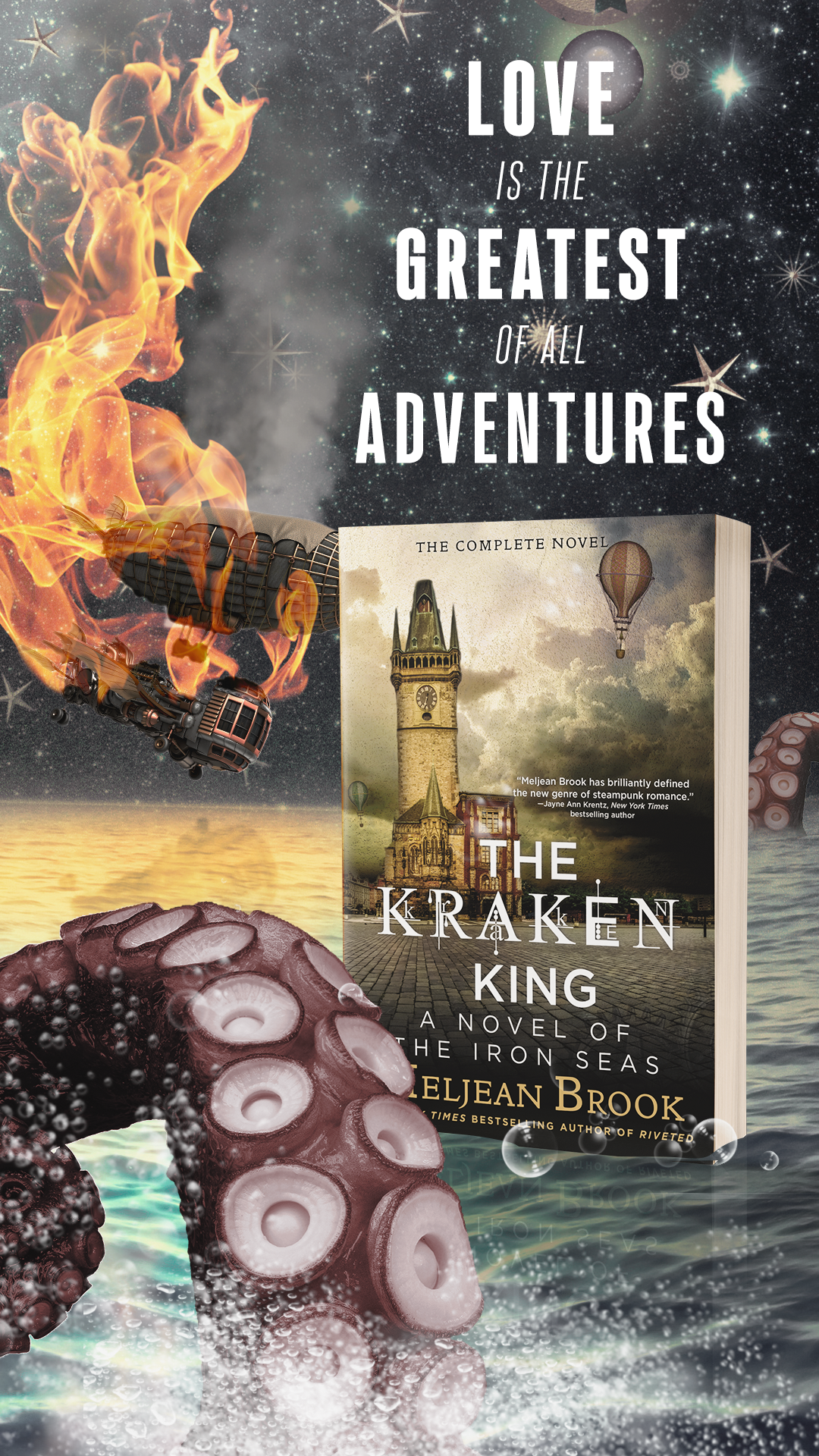
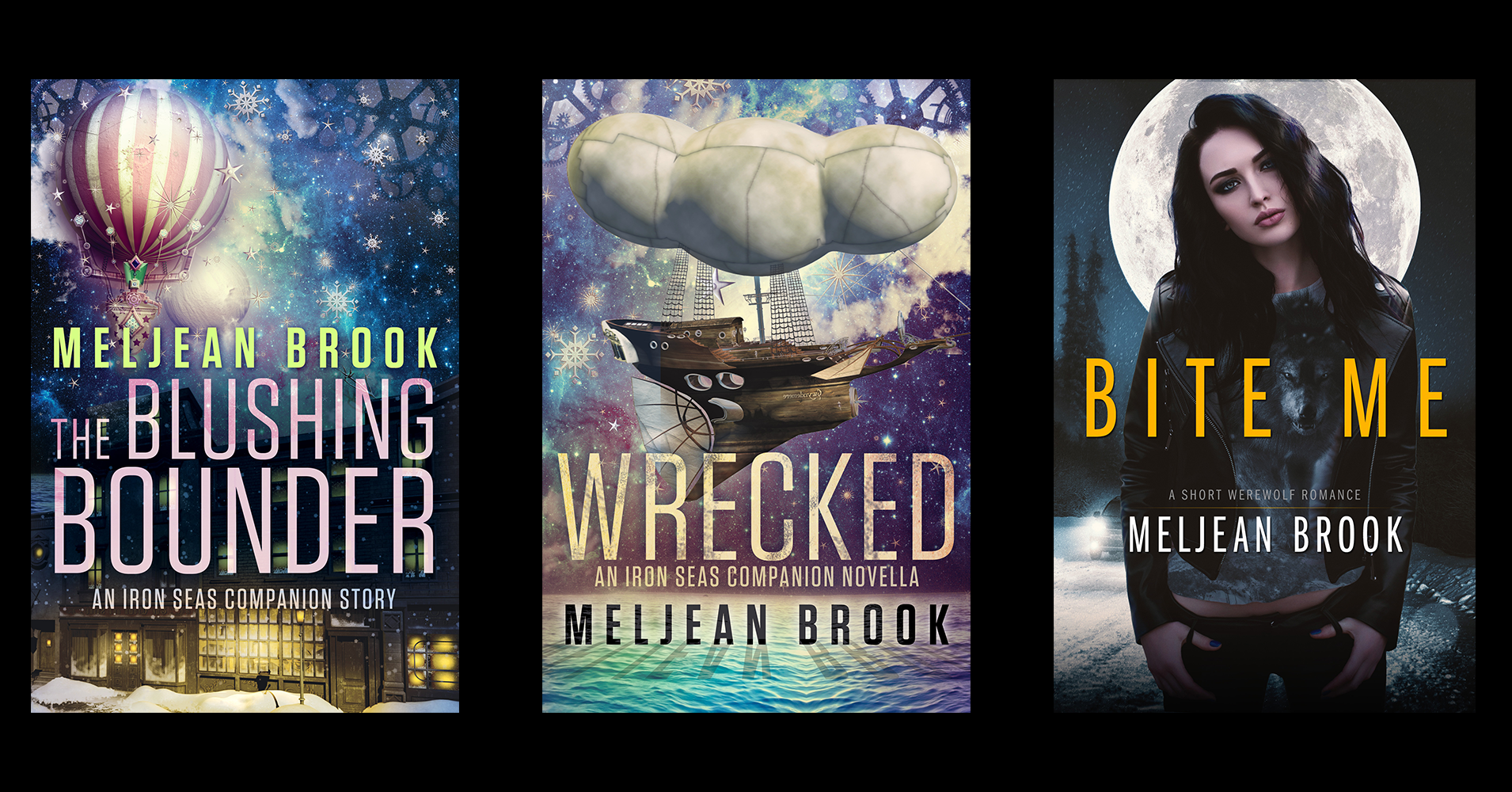
For a preview of my series and a look at steampunk in action, you can check out the excerpt for Here There Be Monsters, an Iron Seas companion novella.
WILL THE BOOKS IN THE IRON SEAS SERIES STAND ALONE?
Absolutely. Although some characters will show up in more than one book and novella, each story will have a self-contained plot and romance.
WHAT HAPPENED THAT DIFFERENTIATES IRON SEAS HISTORY FROM OUR HISTORY?
In our history, two significant events helped form the shape of our world: In 1241, Ögedei Khan, son of Genghis Khan and second khagan of the Mongol Empire, died just as his armies were poised to invade Vienna and continue their conquest of the European continent. Upon receiving news of the Great Khan’s death, Ögedei’s general, Batu Khan, withdrew from Europe, but did not immediately attend the council to formally elect the new Great Khan. Although Guyuk was eventually named khagan in 1246, he died shortly thereafter. Subsequent arguments over succession divided the Mongols and fractured the empire. Though each khanate was still powerful, they did not reattempt their European invasion.
In 1266, Kublai Khan—grandson of Genghis Khan and the ruler who eventually established the Yuan dynasty—entrusted the Polo brothers with a message to Pope Clement IV, who died before they arrived in Rome. The message requested that the pope send one hundred Christian missionaries, including scholars and engineers. The man who would become Pope Gregory X received the missive, but only sent oil from the Holy Sepulcher back with the Polos, who were this time accompanied by Marco Polo.
In the Iron Seas history, Ögedei Khan still dies, but Batu Khan, leader of the Golden Horde, and son of Jochi—Genghis Khan’s eldest son—is named the successor over the wishes of Ögedei’s descendents and their supporters. In the civil war that follows, Batu, a brilliant strategist, crushes his opponents, but the effort prevents him from immediately returning to Europe. He relinquishes his westernmost holdings and consolidates his power in the east. His son, Sartaq, continues to strengthen the reunited empire, establishing strong civil and military presences in the outlying khanates. He is both generous and ruthless, ensuring their loyalty.
The empire is relatively stable by the time the Polo brothers make their first journey along the Silk Road to the emperor’s seat. Though not Kublai Khan, Batu’s successor is not a fool, and he takes similar steps to establish a relationship with the west. Batu and Sartaq had taken pains to maintain their trading routes and roads, so the Polos’ journey back to Rome passes quickly, and they arrive before Pope Clement IV dies. The pope partially fulfills the Great Khan’s request; though he didn’t send one hundred, a handful of scholars and engineers returned east with the Polo brothers, eager to spread both knowledge and Christianity. None were heard from again—except for Marco Polo, who escaped and related horrors of workshops, of men forced to invent machines of war, and who was ridiculed and called mad. For two hundred years, the history of the western world progressed similar to our own, aside from rumors about strange technologies in the east, all of which were dismissed as fables.
Then the first war machines rolled into western Asia, followed by the Horde.
#
Five hundred years later, the populations of Europe and Africa that managed to escape the Horde have fled to the New World, buffered by the protection of the oceans. The Horde has never developed a navy, but its armies and its machines have spread across Eurasia and Africa. What the Horde hasn’t destroyed, it has occupied—levying crippling taxes and enslaving the people, controlling them with the nanotech infecting their cells…and subjecting many to the horror of having their bodies modified to better suit their labor.
England, however, recently broke free from almost two centuries of control, and in a bloody revolution, overthrew Horde rule. But their freedom is tenuous, their position in the international arena weak, and the wounds of the occupation haven’t had time to heal…